
When my oldest son, Devin, was four, his best friend’s dad mentioned signing his son up for soccer.
So, we signed Devin up, too.
I remember thinking that I really didn’t want to give up my Saturdays for soccer.
That’s funny now.
All three of our boys have played soccer. We’ve gone from recreational soccer to travel rec, academy, competitive club soccer, tournaments, college soccer, and more youth soccer leagues and acronyms than I knew existed.
We’ve traveled to Las Vegas and Florida for soccer.
Our weekends revolve around soccer.
We’ve planned vacations around soccer.
Actually, who am I kidding?
Soccer tournaments are our vacations.
And I love it.
But when we first started?
I knew absolutely nothing.
I didn’t know there were different branches of youth soccer. I didn’t understand the difference between recreational and competitive soccer. I didn’t know what academy meant. I didn’t know how travel soccer worked.
And just when you think you finally understand youth soccer, somebody starts talking about ECNL, ECRL, MLS NEXT, Pre-ECNL, or another league you’ve never heard of.
Even now, I sometimes feel like I’m still figuring it out.
So, if you’re a parent with a young soccer player and you’re wondering what all of this means and, more importantly, when you’re supposed to move your kid from one level to another, this is the explanation I wish someone had given me years ago.
First, Youth Soccer Isn’t Organized the Same Everywhere
Let’s get this out of the way first.
There isn’t one perfect national ladder that looks like this:
Recreational → Travel Rec → Academy → Competitive → Elite
I wish it were that easy.
Terms such as academy, select, club, competitive, and travel can mean different things depending on your club, league, state, and soccer organization.
Even the organizations governing youth soccer distinguish broadly between recreational and competitive players. For example, US Club Soccer notes that recreational players generally aren’t expected to travel, while its competitive programs use player passcards and can participate across sanctioned competitions.
But once you get down to individual clubs, there can be many different programs within those larger categories.
So, before signing your child up for anything, ask the club exactly what its program includes.
- How many practices?
- How many games?
- Are there tryouts?
- Is the commitment seasonal or year-round?
- How much travel?
- How many tournaments?
- What does the fee actually include?
Those questions will tell you much more than the word academy printed on a website.
Recreational Soccer: Where Most Kids Start
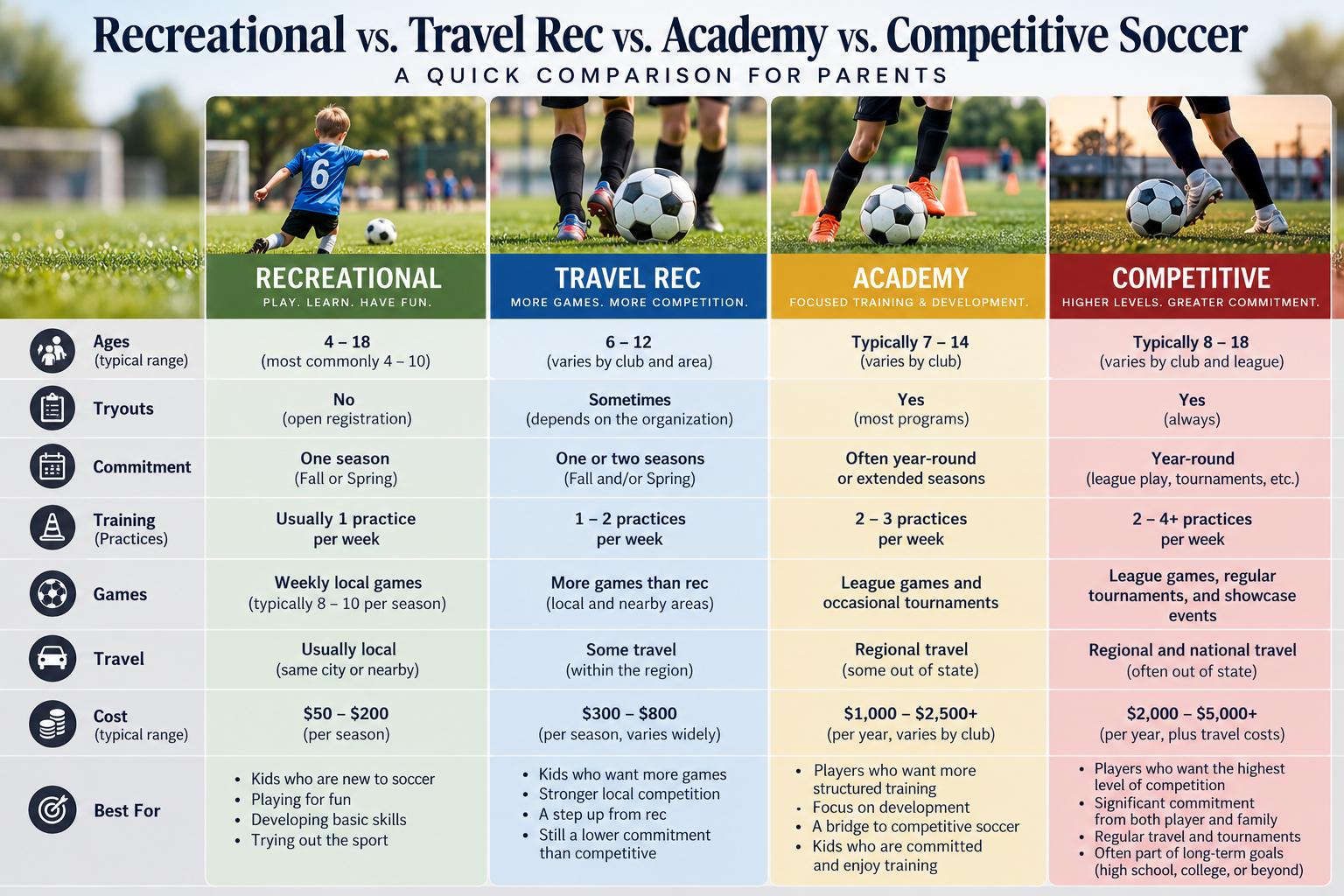
All three of our boys started in recreational soccer.
Devin started when he was four while we were living in Arkansas and later continued playing rec after we moved to Oklahoma.
Braden and Austin both started recreational soccer here in Oklahoma when they were five, although they played at different facilities.
Rec soccer is exactly where I’d tell most families to start.
At this age, kids need to play.
They need touches on the ball.
They need to learn how the game works.
They need to figure out whether they even like soccer.
And parents need to figure that out, too.
Because your five-year-old enjoying soccer doesn’t mean your family needs to immediately start researching elite soccer clubs.
Let them play.
What Is Travel Rec Soccer?
Travel recreational soccer was our next step with Devin.
This is also one of those terms that can vary depending on where you live.
In our experience, it was still much closer to recreational soccer than competitive club soccer, but the team played stronger competition and traveled to play other teams.
Mike and Coach Dave coached Devin’s team.
And they were good.
The boys developed. They competed. They had fun.
Eventually, though, Mike and Dave realized something important.
The players had gone beyond what they could teach them.
That wasn’t a failure on their part.
Actually, I think recognizing it was one of the best things they could have done for those kids.
They’d taken them as far as they knew how to take them.
Six players from that team eventually moved to Crew with us. Others went to different clubs. Some stayed in recreational soccer.
Every kid took a different path.
That’s something I wish more parents understood.
There isn’t one correct next step.
What Is Academy Soccer?
Austin is giving us our first real experience with academy soccer.
He played recreational soccer for two years with a little team called the Vipers at NOKC.
We loved that team.
But we saw something in Austin that made us think he needed more training.
So, we moved him to the academy at Crew.
Not because we think he’s going to be the next Messi.
He’s still a kid.
We moved him because the environment he was in wasn’t giving him everything he needed anymore.
We already knew and trusted the Crew coaches. We liked the club. We liked the parents. Austin fit there.
And, most importantly, he wanted to keep playing.
That’s what academy means to us at this stage: more focused training and development without treating a young child’s soccer career like his entire future has already been decided.
Your local club’s academy program may look different, which is why I’d ask about training, coaching, games, travel, and expectations rather than relying on the name alone.
What Is Competitive Club Soccer?
Competitive soccer was a much bigger change for our family.
We moved Devin to Crew during his freshman year of high school.
Looking back, I think we probably waited a little too long.
But we’d had a good situation with Mike and Dave coaching, and Devin was still developing.
Eventually, though, it became obvious that Devin wanted more.
He wanted to play soccer in college.
If that was his goal, he needed coaching, competition, and opportunities beyond what his current team could provide.
Competitive club soccer gave him that.
It also introduced us to an entirely different level of commitment.
Competitive wasn’t simply another fall soccer season.
It was the soccer year.
There were tryouts.
There were club fees.
There were uniforms.
There were multiple practices each week.
There were league games.
There were tournaments.
There was travel.
And then there were hotels, food, gas, airfare, and all the other expenses that come along with traveling.
One thing I loved about Devin’s experience at Crew was that he had opportunities to play on multiple teams and with different age groups.
He got a tremendous amount of experience that way.
But competitive soccer isn’t simply recreational soccer with better uniforms.
It’s a bigger commitment for both the player and the family.
So, When Should You Move Your Child Up?
This is probably the question I would have wanted answered most when our boys were younger.
And now I think the answer is:
When their current environment is no longer giving them what they need.
Not because another parent moved their kid.
Not because you’re worried your seven-year-old is falling behind.
Not because someone convinced you that your child needs to get into an elite pathway immediately or they’ll never make it.
Look at your child.
Are they asking for more?
Do they love playing?
Are they practicing without being forced?
Do they want better competition?
Have they outgrown what their current coaches can teach them?
Would more structured training help them?
Most importantly:
Do they want this?
Because the answer can be different for every kid.
I know that firsthand.

Three Kids. Three Completely Different Soccer Paths.
Our boys are a pretty good example of why there isn’t one youth soccer path.
Devin
Devin went from recreational soccer to travel rec and eventually competitive club soccer.
He wanted to keep improving.
He wanted to play in college.
Today, he’s doing exactly that, and we’ve learned even more about the path from college soccer toward playing professionally.
Could we have moved him to competitive soccer earlier?
Probably.
But his path still got him where he wanted to go.
Braden
We moved Braden to Crew the year after Devin.
He played competitive soccer for two years.
And he absolutely could have continued.
Talent wasn’t the problem.
He didn’t want to.
He didn’t want to spend his extra time juggling a soccer ball.
He didn’t want to work on goalie training outside of practice.
He didn’t want soccer badly enough to make that level of commitment worthwhile.
So, eventually, he stopped.
Now he’s playing football, although he’s talked about trying out as a goalkeeper for his middle school soccer team.
And that’s okay.
I could look at him and think about what kind of soccer player he could have been.
But it’s not my soccer career.
It’s his.
Austin
Austin is now in academy.
We see potential in him, and we want to give him better training.
That’s it.
Maybe he’ll eventually move into competitive soccer.
Maybe he’ll play in high school.
Maybe he’ll play in college.
Maybe he’ll decide in a few years that he’d rather do something completely different.
We don’t know.
He’s seven.
We’re going to let him play soccer.
Please Don’t Spend Thousands Because Your 7-Year-Old Might Be the Next Messi
This is where youth soccer gets touchy.
And I understand why.
Parents want to give their kids opportunities.
We do, too.
But I don’t think parents need to panic about their seven- or eight-year-old’s soccer career.
Kids change.
Interests change.
Bodies change.
Motivation changes.
The child who lives and breathes soccer at seven may want absolutely nothing to do with it by middle school.
And the kid who isn’t playing at the highest level at eight isn’t necessarily doomed.
Youth soccer in the United States can also become expensive very quickly.
There is a legitimate access issue within a system where many competitive opportunities require families to pay club fees and then absorb travel and tournament costs on top of them. Even some of the country’s elite development organizations recognize the financial barrier. MLS NEXT, for example, introduced scholarship requirements for its clubs beginning with the 2025-26 season to increase access for players who otherwise might not be able to afford participation.
That doesn’t mean club soccer is bad.
We love club soccer.
But paying more money doesn’t automatically mean your child will become a better player.
And it definitely doesn’t guarantee playing time, a college scholarship, or a professional career.
Spend money because you’ve looked at the environment, the coaching, your child’s needs, and your family’s situation and decided it’s worth it.
Not because someone made you afraid your second grader is falling behind.
Competitive Soccer Is a Family Commitment
This is another thing parents need to understand before moving into higher levels.
The player isn’t the only one joining the club.
Your family is joining the club.
Right now, we train twice a week.
We can have games on both Saturday and Sunday.
There are tournaments.
As players get older and competition increases, there can be more travel.
We’ve traveled to Las Vegas.
We’ve traveled to Florida.
And I genuinely love it.
Those trips became family memories. We joke that we don’t really take traditional vacations.
We take soccer vacations.
But there’s another part of the family commitment that doesn’t get talked about enough:
The siblings are along for the ride, too.
Austin has basically grown up on a soccer field.
He was a baby when we were taking Devin to futsal and travel rec games. When we moved Devin to Crew, Austin was only three.
So, while Devin was the one playing soccer, club soccer became part of Austin’s life, too.
We had to bring things to keep him occupied. He spent countless hours on sidelines and at soccer complexes. He went to tournaments. He traveled with us. He watched practices and games.
In a weird way, Devin’s soccer experience was part of Austin’s childhood.
And now that Austin is the one playing, I actually think growing up around soccer has helped him. The environment isn’t strange to him. Being at the fields feels normal. Soccer has always just been part of our family’s life.
That’s something parents of younger siblings should think about when considering the commitment, too.
If one child plays competitive soccer, you’re not only deciding how much of your time will be spent at practices, games, and tournaments. You’re deciding how much of your other children’s time will be spent there, too.
Sometimes that can be difficult.
Sometimes you’re trying to entertain a toddler through an entire soccer game.
Sometimes siblings get dragged somewhere they’d rather not go.
And sometimes those weekends on the sidelines become part of their childhood in ways you don’t realize until years later.
For us, they’ve become family memories.
But that’s our family.
Another family might look at that schedule and think it sounds miserable.
Neither family is wrong.
You just need to understand what you’re signing up for, because when one child plays competitive soccer, the whole family is along for the ride.
The Player Has to Want It
This might be the most important part of the entire post.
Competitive soccer requires commitment from the player.
You can pay the fees.
You can drive to practice.
You can book the hotel.
You can buy the uniform.
You can hire trainers.
You can stand on the sideline every weekend.
But you cannot want it more than your kid does.
Braden taught me that.
He was capable of playing competitive soccer.
But he wasn’t interested in doing the extra work.
And there’s no point spending thousands of dollars and rearranging the entire family’s schedule trying to manufacture a passion that isn’t there.
Don’t force it.
And don’t live through your kid.
Let them play.
Let them touch the ball.
Let them play pickup games and street soccer.
Let them have fun.
If they want more, help them find more.
And Then Comes the Soccer Alphabet Soup
Eventually, if your child keeps moving through competitive soccer, you’ll start hearing things like:
ECNL. ECRL. MLS NEXT. Pre-ECNL.
And you’ll think:
Wait. I thought I finally understood this.
Welcome to youth soccer.
These aren’t simply synonyms for competitive soccer. They’re specific leagues or development platforms within the broader competitive landscape.
For example, the ECNL currently operates ECNL, ECNL Regional League, and Pre-ECNL pathways, with hundreds of clubs participating across its different levels.
MLS NEXT is another high-level development platform. For the 2026-27 season, it includes more than 53,000 players and over 300 clubs across its Homegrown and Academy divisions. Its Homegrown Division operates a 10-month, pro-style season, while its newer Academy Division expands high-level opportunities to additional clubs and players.
And those aren’t the only pathways.
You do not need to understand all of this when your child first puts on shin guards.
I certainly didn’t.
As your player progresses, learn about the opportunities that actually apply to them.
You don’t need to memorize the entire American youth soccer system.
I’m not convinced anyone actually understands the entire American youth soccer system.
Be Careful With the Promise of Being “Discovered”
Here’s another thing I wish I’d understood better when Devin was younger.
Soccer camps.
We went into some of them believing they might be an opportunity for Devin to get noticed or picked up.
Looking back, I think I placed too much importance on that.
That doesn’t mean soccer camps are worthless.
A good camp can provide:
- Extra training
- More touches on the ball
- Different coaching
- A fun soccer experience
- Exposure to a particular college or program
But I would be very cautious about spending large amounts of money because you think one camp is going to be the place where someone magically discovers your child.
There are legitimate identification programs that work differently. For example, US Club Soccer’s id2 National Identification and Development Program specifically says players should initially be scouted in their regular club training and competition environments, and participation in id2 is free.
That was eye-opening to me.
A legitimate development pathway doesn’t necessarily require you to chase every expensive “exposure” opportunity that lands in your inbox.
Ask questions.
- Who will actually be there?
- Who is doing the evaluating?
- What happens after the camp?
- Is this primarily training?
- Is it truly an identification event?
- What are you actually paying for?
Sometimes the answer may still be, “This looks fun, and my kid wants to go.”
That’s a perfectly good reason.
Just know what you’re buying.
What I’d Tell a New Soccer Parent Now
If I could go back and talk to the version of myself who didn’t want to give up her Saturdays for four-year-old soccer, I’d tell her a few things.
Start with rec.
Let your kid learn the game.
Don’t worry about what every other soccer parent is doing.
Don’t assume more expensive automatically means better.
Pay attention to the quality of the coaching.
When your child outgrows an environment, look for the next one.
If they want more, help them get more.
If they don’t want more, listen to them.
Don’t spend money because you’re afraid they’re falling behind.
Don’t mistake your child’s potential for your child’s desire.
And don’t become so focused on where soccer might take them that you forget to enjoy where they are right now.
Because somehow those Saturday morning games with four-year-olds turn into club tournaments.
Then high school.
Then college.
And suddenly, the Saturdays I didn’t want to give up became some of my favorite parts of raising our boys.
I still don’t understand every league, every pathway, or every acronym in American soccer.
But I finally understand the part that matters most.
Find the level that gives your child what they need right now, and let the next step come when they’re ready for it.